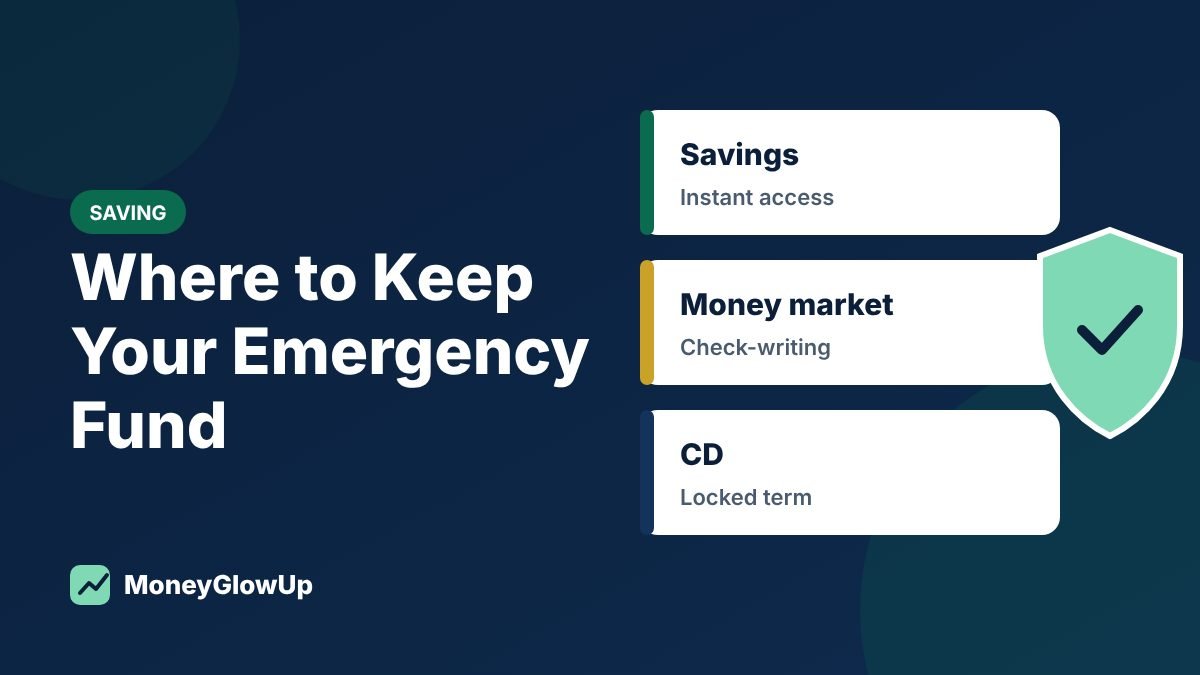
Your emergency fund should be safe, separate and quick to reach. For most people that means an insured savings account at a bank or credit union. Here is how the common options compare.
The three tests
- Safe: the value shouldn’t fall when you need it most.
- Accessible: money available within a day or two without big penalties.
- Separate: not mixed with everyday spending, so it isn’t spent by accident.
How the options compare
| Option | Insured? | Access | Watch out for |
|---|---|---|---|
| Savings account (bank or credit union) | Yes — FDIC or NCUA, up to $250,000 per depositor, per institution, per ownership category | Usually 1–2 business days to transfer | Low rates at some banks; monthly fees |
| Money market deposit account | Yes, when held at an insured bank or credit union | Similar to savings; may include checks | Minimum balances |
| Certificate of deposit (CD) | Yes, at insured institutions | Locked for a set term | Early withdrawal penalties |
| Money market fund (brokerage) | No — not FDIC insured | Usually any business day | Can lose value (rare, but possible) |
| Stocks or crypto | No | Fast to sell | Prices can drop exactly when you need cash |
Money market account vs. money market fund
The names sound alike but they are different products. A money market deposit account is a bank deposit. A money market fund is an investment: the SEC notes it is not guaranteed by the FDIC and that you could lose money, even though most aim to keep a stable $1.00 share price.
What about CDs?
CDs can work for part of a larger fund — for example, money you are sure you won’t need for a year — but check the early-withdrawal penalty before you buy. Many people keep at least the first few months of expenses in an ordinary savings account.
Illustrative example (made-up numbers): a two-layer setup
Riley’s goal is $6,000. The first $3,000 stays in an online savings account for instant access. The next $3,000 sits in a separate savings bucket at the same insured bank, labeled “Do not touch — emergencies.” Riley avoids CDs until the full goal is reached.
Quick checklist before you open an account
- Confirm the institution is FDIC- or NCUA-insured (check the official FDIC BankFind or NCUA tools).
- Read the fee schedule and minimum balance rules.
- Check how long transfers to your checking account take.
- Turn on alerts so you notice any unexpected withdrawal.
How to check that an account is insured
- For banks, look the institution up in the FDIC’s BankFind tool and look for the FDIC sign on its website.
- For credit unions, check that it is federally insured by the NCUA.
- Be careful with apps and fintech companies. Some are not banks themselves — your money may be insured only once it reaches a partner bank, and only under certain conditions. Read the disclosures.
Common mistakes
- Keeping it in checking. It is too easy to spend by accident. A separate savings account keeps it out of sight.
- Chasing the highest rate only. Insurance, access and fees matter more for emergency money than a small difference in interest.
- Investing all of it. Stocks and crypto can fall exactly when you need the cash.
- Locking everything in a CD. Early-withdrawal penalties can eat your interest when an emergency hits.
Frequently asked questions
Is a high-yield savings account safe for an emergency fund?
It can be, if it is a deposit account at an FDIC-insured bank or NCUA-insured credit union and you stay within the insurance limits. “High-yield” describes the rate, not the safety.
Should my emergency fund be at a different bank from my checking account?
Some people find a separate bank helps them avoid spending it, because transfers take a day or two. Others prefer the same bank for instant transfers. Both work if the account is insured.
Are money market funds FDIC insured?
No. A money market fund is an investment, not a deposit. A money market deposit account at an insured bank is a different product and is insured.
How much should I keep in my emergency fund?
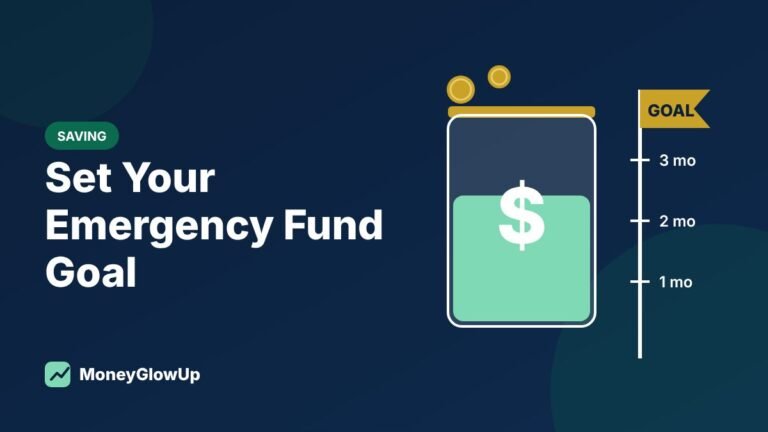
See How to Set an Emergency Fund Goal to calculate a starter goal and a full goal from your own expenses.
Next step
If you haven’t picked a target yet, start with How to Set an Emergency Fund Goal, then automate a transfer the day after payday.
Sources
- FDIC — Understanding Deposit Insurance (accessed Oct 29, 2026)
- NCUA — Share Insurance Coverage (accessed Oct 29, 2026)
- U.S. SEC — Investor.gov — Money Market Funds (accessed Oct 29, 2026)
- U.S. SEC — Investor.gov — Certificates of Deposit (CDs) (accessed Oct 29, 2026)