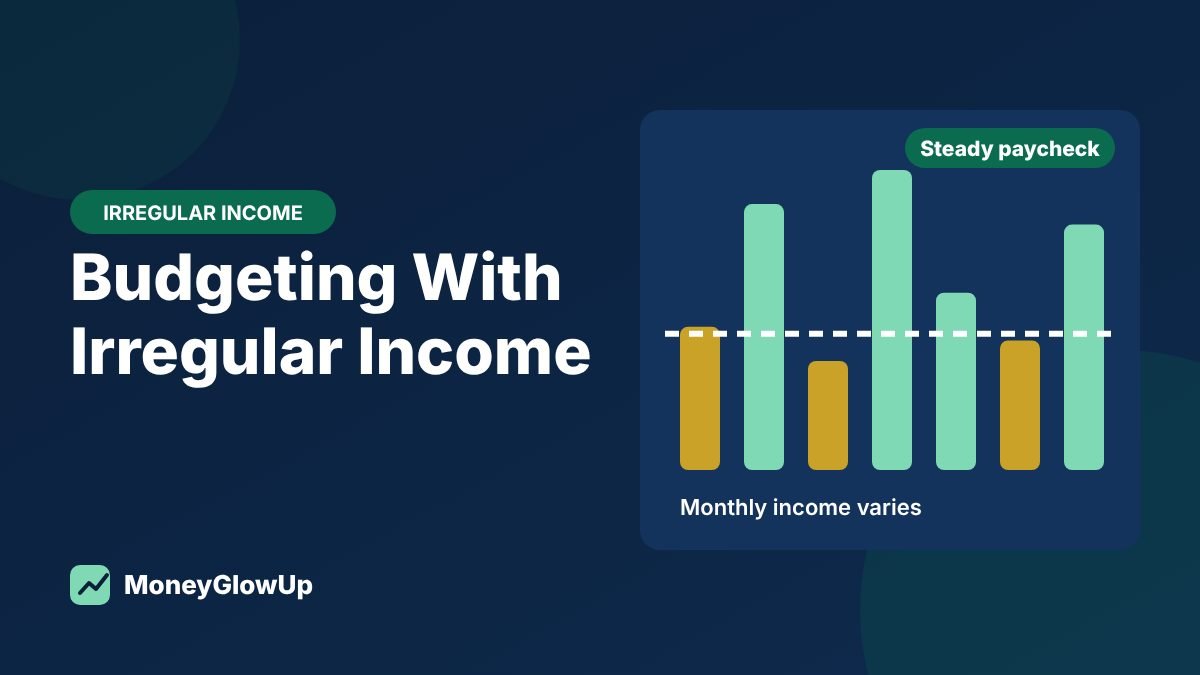
If your income changes from month to month — freelance work, commissions, tips, gig apps — the trick is to budget from your low months, not your good ones, and smooth the difference with a holding account. Here is a simple system.
Step 1: Find your baseline
Look at at least 6–12 months of income. Note the average and the lowest month. Your core budget — essentials and minimum payments — should fit inside the lowest realistic month.
Illustrative example (made-up numbers): six months of freelance income
| Month | Income |
|---|---|
| Month 1 | $2,800 |
| Month 2 | $4,100 |
| Month 3 | $1,900 |
| Month 4 | $3,600 |
| Month 5 | $5,200 |
| Month 6 | $2,500 |
Total $20,100 → average $3,350; lowest month $1,900. Budgeting from the average would leave this person short in three of six months, so essentials are planned to fit within about $1,900.
Step 2: Use a holding account and pay yourself a “salary”
- Deposit all business or gig income into one holding account.
- Each month, transfer a fixed “salary” to your everyday account — start near your baseline.
- Leave the surplus from good months in the holding account to cover lean ones.
- Once the holding account covers a month or two of your salary, consider raising the salary gradually.
Step 3: Set money aside for taxes first
Freelance income usually has no tax withheld. In the U.S., self-employment tax is 15.3% (12.4% Social Security and 2.9% Medicare) and generally applies if your net earnings from self-employment are $400 or more — on top of any income tax you owe.
If you expect to owe $1,000 or more when you file, the IRS generally expects estimated tax payments during the year. The individual due dates are:
| Income earned | Payment due |
|---|---|
| Jan 1 – Mar 31 | April 15 |
| Apr 1 – May 31 | June 15 |
| Jun 1 – Aug 31 | September 15 |
| Sep 1 – Dec 31 | January 15 (next year) |
How much to set aside depends on your income, deductions and state. A practical habit is to move a fixed share of every payment into a separate tax account as soon as it arrives, then check the amount with the IRS Form 1040-ES worksheet or a tax professional. This is general education, not tax advice.
Step 4: Prioritize in lean months
| Priority | Examples |
|---|---|
| 1. Essentials | Housing, utilities, food, transportation to work |
| 2. Minimum payments | Avoid late fees and credit damage |
| 3. Taxes set aside | Keep the tax account untouched |
| 4. Savings & extras | Pause or shrink until income recovers |
Track variable spending closely during lean months — our spending tracker guide shows a quick weekly routine.
Build a holding-account buffer in stages
| Stage | Goal | What it does |
|---|---|---|
| 1 | One month of your “salary” in the holding account | Covers one slow month without stress |
| 2 | Two to three months of salary | Lets you keep paying yourself through longer dry spells |
| 3 | Raise your salary gradually | Only when the buffer stays full for several months |
Common mistakes
- Spending a big month right away. Good months fund the lean ones. Move the surplus to the holding account first.
- Treating tax money as income. Move the tax share to its own account as soon as you are paid.
- Forgetting business costs. Software, fuel, equipment and platform fees come out before your personal budget.
- Raising your salary too fast. Increase it only when your buffer has stayed full for a while.
Illustrative example (made-up numbers): a lean month with a buffer
Using the six months above, the freelancer pays themself a $2,200 monthly salary from the holding account. In Month 3, income is only $1,900, so the holding account covers the $300 difference. The surplus from Month 2 ($4,100 − $2,200 = $1,900, before setting money aside for taxes) is what makes that possible.
Frequently asked questions
How do I choose my “salary” amount?
Start near your lowest realistic month, after setting aside taxes and business costs. It is better to start low and raise it than to start high and run out.
Do I need a separate business account?
It is not always required, but a separate account for business income makes the holding-account system and tax records much easier.
Do I have to make estimated tax payments?
Generally, if you expect to owe $1,000 or more when you file, the IRS expects quarterly estimated payments. Check the IRS pages below or ask a tax professional about your situation.
What if I’m paid partly by paycheck and partly by gigs?
Budget essentials from the steady paycheck if you can, and treat gig income as extra for the holding account, savings and taxes.
Next step
Pull your last six months of deposits, find your lowest month, and build your essentials budget to fit it. Then add a sinking fund for irregular costs so they don’t land in a lean month.
Sources
- Internal Revenue Service — Self-employment tax (Social Security and Medicare taxes) (last reviewed Jun 27, 2026) (accessed Oct 29, 2026)
- Internal Revenue Service — Estimated taxes (last reviewed Sep 25, 2026) (accessed Oct 29, 2026)
- Internal Revenue Service — When to pay estimated tax (last reviewed Oct 2, 2026) (accessed Oct 29, 2026)
- Consumer Financial Protection Bureau — Creating a cash flow budget (Your Money, Your Goals tool) (accessed Oct 29, 2026)