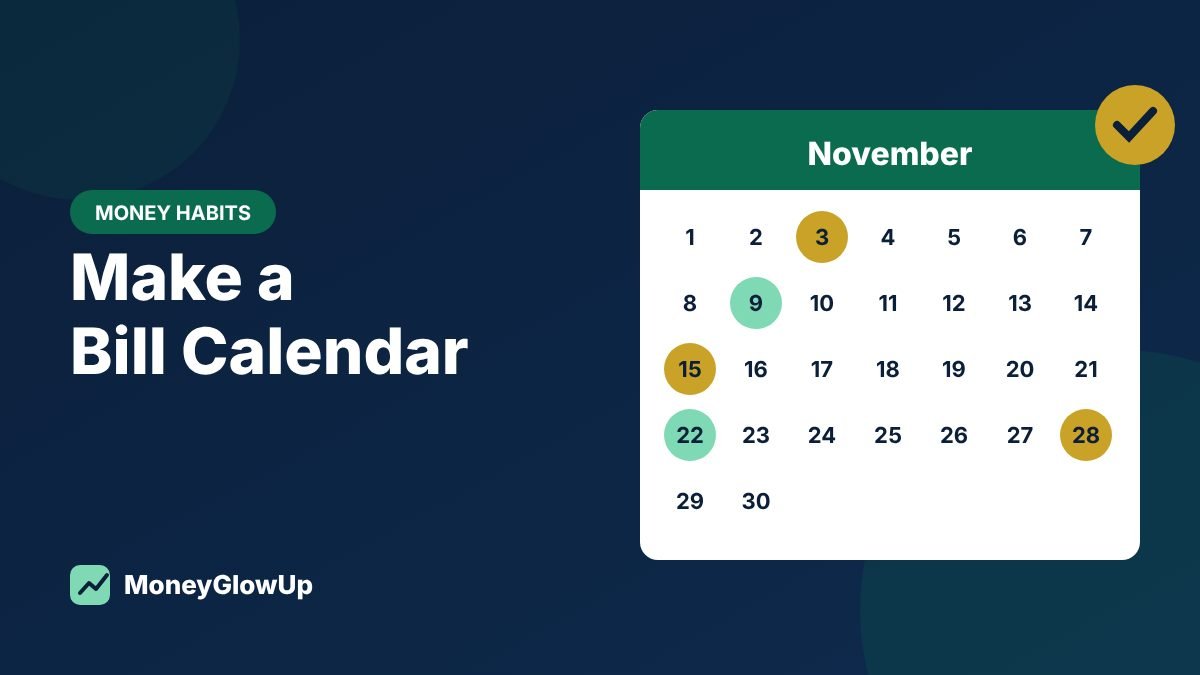
A bill calendar shows every bill’s amount and due date in one place, so nothing sneaks up on you. Ten minutes to set up can save you late fees and the stress of wondering what is due next.
Step 1: List every recurring bill
Go through two or three months of bank and card statements. Include rent, utilities, phone, insurance, loan and card payments, subscriptions and annual renewals.
Step 2: Put them on a calendar
| Bill | Due | Amount | How paid | Paid? |
|---|---|---|---|---|
| Rent | 1st | $1,100 | Bank bill pay | ☐ |
| Phone | 8th | $45 | Autopay (card) | ☐ |
| Credit card | 15th | Varies | Manual | ☐ |
| Electric | 22nd | Varies | Autopay (bank) | ☐ |
Use whatever you will look at: a phone calendar with alerts, a spreadsheet, or the CFPB’s printable tool.
Step 3: Match bills to paydays
If you are paid twice a month, split bills into “first paycheck” and “second paycheck” groups. Many lenders and card issuers let you request a different due date — ask if a due date always lands before payday.
Step 4: Decide what to automate
| Automatic payments | Things to know |
|---|---|
| Pros | Fewer missed due dates; less to remember |
| Risks | If your balance is low, you may face overdraft or non-sufficient-funds fees from both your bank and the company |
| Your rights | If an automatic amount will differ from what you authorized, the company must notify you at least 10 days before (CFPB) |
A common middle ground: automate fixed bills, pay variable ones manually after checking the amount, and keep a small buffer in checking.
Why “on time” can still mean a late fee
For credit cards, a payment generally must be received by 5 p.m. (in the time zone where payments are received) on the due date. Mailing a check on the due date, or paying less than the minimum, can still trigger a fee. Paying a few days early avoids the problem.
Step 5: Review weekly
Each week, tick off paid bills and look at the next seven days. Pair this with your weekly spending check-in so it becomes one quick routine.
Common mistakes
- Leaving out annual and quarterly bills. Car registration, insurance and memberships are the ones that surprise people.
- Trusting autopay blindly. Check the amount on variable bills and make sure the account has enough money.
- Paying on the due date by mail. Mail takes time — pay a few days early.
- Never updating it. When a bill changes or ends, update the calendar the same day.
Paycheck planner: which bills each paycheck covers
Illustrative example (made-up numbers): paid on the 1st and 15th
| Paycheck | Bills due before the next paycheck | Total |
|---|---|---|
| 1st ($1,450) | Rent $1,100 · Phone $45 · Gym $30 | $1,175 |
| 15th ($1,450) | Credit card $150 · Electric ~$90 · Car insurance $120 · Internet $60 | ~$420 |
The first paycheck carries most of the fixed bills, so this person moves extra savings and spending money to the second paycheck to keep both halves balanced.
Frequently asked questions
Paper or app?
Whichever you will check every week. Phone calendars with alerts are easy; the CFPB’s printable calendar works well if you like paper.
Can I change a bill’s due date?
Many lenders, card issuers and utilities allow it. Call or check your online account and ask.
What if I can’t pay every bill this month?
Contact the company before the due date to ask about options, and prioritize essentials like housing, utilities and food. The CFPB has tools for people who are behind on bills.
Next step
Add yearly bills too — then fund them with a sinking fund so they never surprise you.
Sources
- Consumer Financial Protection Bureau — Bill calendar tool (Your Money, Your Goals) (accessed Oct 29, 2026)
- Consumer Financial Protection Bureau — How do automatic payments from a bank account work? (accessed Oct 29, 2026)
- Consumer Financial Protection Bureau — I paid my bill on time last month and still was charged a late fee. How can that be? (last reviewed Sep 23, 2024) (accessed Oct 29, 2026)