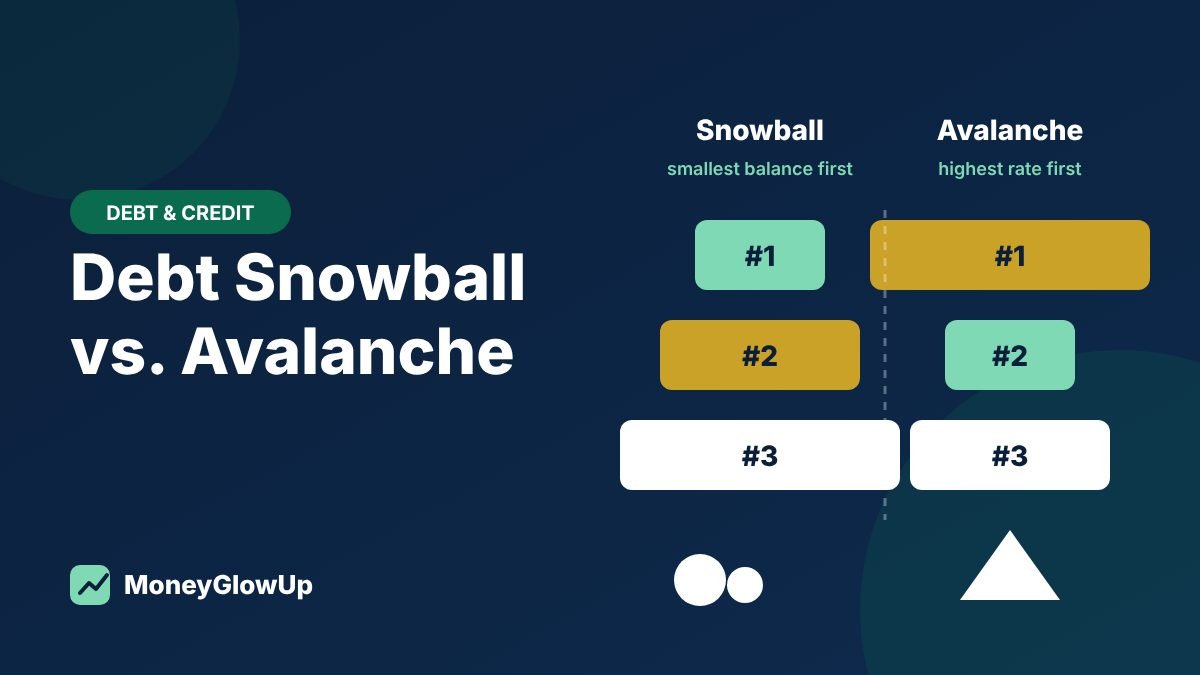
Both methods pay every minimum and put extra money toward one debt at a time. Snowball targets the smallest balance first for quick wins. Avalanche targets the highest interest rate first to pay less interest. With the numbers below, avalanche saved about $266 and one month — but snowball delivered its first win ten months sooner.
The two methods in one table
| Debt snowball | Debt avalanche | |
|---|---|---|
| Order | Smallest balance → largest | Highest interest rate → lowest |
| Strength | Fast early wins that keep you motivated | Usually the lowest total interest |
| Weakness | Can cost more interest | First payoff can take a long time |
A worked comparison
Illustrative example (made-up numbers): $7,600 of debt, $500 a month to pay it
| Debt | Balance | APR | Minimum |
|---|---|---|---|
| Personal loan | $900 | 6% | $40 |
| Card A | $4,200 | 24% | $105 |
| Card B | $2,500 | 18% | $65 |
Minimums total $210, leaving $290 extra each month. We simulated both methods month by month (interest charged monthly at APR ÷ 12, freed-up minimums rolled into the next target):
| Result | Snowball | Avalanche |
|---|---|---|
| First debt paid off | Month 3 (personal loan) | Month 13 (Card A) |
| Debt-free | Month 19 | Month 18 |
| Total interest paid | $1,407.26 | $1,140.98 |
Avalanche saves $266.28 and one month here. Your numbers will differ — the gap grows when high-rate balances are large.
How to choose
- Pick avalanche if you are motivated by the math and can stay on track without an early win.
- Pick snowball if you have tried before and lost momentum — finishing a debt quickly can help you keep going.
- Hybrid: clear one very small balance first for a win, then switch to avalanche.
Make either method work
- Never miss a minimum — late payments add fees and can hurt your credit.
- Put your extra payment on a bill calendar the day after payday.
- Keep a small starter emergency fund so surprises don’t go back on a card.
- Stop adding new balances to the cards you are paying off.
Balance transfers and consolidation loans can lower interest but often carry fees and promotional periods that end. Read the terms carefully before using them; this guide doesn’t evaluate specific products.
Before you choose: protect the debts with the biggest consequences
The CFPB’s “Lowering your debt” tool suggests listing debts starting with those that have the most serious consequences if you miss a payment. Rent or mortgage, utilities, car loans you need for work, and court-ordered debts can lead to eviction, shut-offs, repossession or legal trouble. Keep those current before you put extra money toward any card or loan.
If you can’t cover minimums at all, snowball vs. avalanche isn’t the question yet. The CFPB suggests contacting creditors about payment plans and considering nonprofit credit counseling, and warns about debt-settlement companies that charge fees before settling anything or promise to make your debt go away.
Step-by-step: set up your plan
- List every debt: balance, interest rate (APR) and minimum payment.
- Decide your total monthly debt budget from your monthly budget.
- Subtract all minimums — what is left is your extra payment.
- Order the list: smallest balance first (snowball) or highest APR first (avalanche).
- Pay minimums on everything and the extra on the first debt in your list.
- When a debt is paid off, add its minimum to the extra and move to the next one.
Common mistakes
- Changing methods every month. Pick one and stick with it for at least a few months.
- Using the extra for new spending. When a debt is gone, its payment should roll forward, not disappear.
- No emergency savings. Without a small buffer, the next surprise goes back on a card.
- Ignoring the rates. Even if you choose snowball, check whether any very high-rate debt is growing fast.
Frequently asked questions
Which method is faster?
In our example, avalanche finished one month sooner and cost less interest. Snowball paid off the first debt much sooner. Results depend on your balances and rates.
Does either method hurt my credit?
The method itself doesn’t. Paying every bill on time and reducing balances generally helps. Closing cards after paying them off can affect your credit utilization, so think it through first.
Should I include my car loan or student loans?
You can include any debt, but many people focus extra payments on high-interest debt first and simply keep lower-rate loans current.
Next step
List every debt with its balance, APR and minimum, then decide your monthly extra amount using your monthly budget.
Sources
- Consumer Financial Protection Bureau — Lowering your debt (Your Money, Your Goals companion tool, 2021) (accessed Oct 29, 2026)
How we calculated this
Our simulation charged one month of interest on each balance (APR ÷ 12), paid all minimums, then applied the remaining amount of the $500 budget to the target debt, rolling over any leftover the month a debt was paid off. It ignores fees, rate changes and new charges.